Author Website
Jaime Pasquier
Author Philosopher Historian


Family, History, and Virtue
Jaime Pasquier is a #1 Amazon bestselling author who writes across history, philosophy, and fiction, chasing a single question: what forces shape human character and political destiny? Trained in economics and the humanities and forged by four decades running his own financial services firm, he brings a rare, multidisciplinary eye to stories of power, morality, and the quiet decisions that redirect lives and nations.
His work spans ancient wisdom and modern longing. The Virtuous Life traces the philosophical traditions that built Western civilization and asks whether we still have the character to sustain it; The Laws of Desire mines two thousand years of writing on love to examine how we court and disconnect today. In fiction, The Last Aristocrats follows a French nobleman's murder, faked death, and long exile across two continents, while The Scandal That Shook the Throne—and its Spanish companion, Cuarenta y Siete Puñaladas—moves through royal courts, political intrigue, and moral trials that test ordinary people in extraordinary times. Writing in English, Spanish, and French from Washington, D.C., Jaime blends historical depth with contemporary urgency.
My Books

The Virtuous Life: Ancient Wisdom for Modern Living
#1 Amazon Bestseller
#1 AMAZON BEST SELLER IN GREEK & ROMAN PHILOSOPHY
TOP 10 BEST SELLER IN 17TH & 18TH CENTURY PHILOSOPHY
TOP 5 BEST SELLER IN ETHICS & MORALITY
ANCIENT WISDOM. PROVEN BY TIME.
You were not made for this. You feel it not as a sudden crisis, but as a quiet thinning — life growing faster, louder, and somehow emptier. You have optimized your mornings, hit your targets, and chased every metric of modern success, only to find that "arriving" feels no different than running.
Jaime Pasquier spent forty years in the financial world watching this pattern repeat. Not in struggling careers — in successful ones. The higher the achievement, the quieter and more persistent the erosion. What he observed across four decades is this: Technical skill determines who gets to the table. Character determines who stays standing.
The Virtuous Life begins where the self-help industry ends.
Drawing on the most enduring frameworks in human history — Stoic, Aristotelian, Buddhist, and Confucian — Pasquier reconstructs the foundations of character: not as ideals, but as skills you can build. A practical system for developing an inner foundation that does not collapse under pressure, temptation, or the slow drift that professional success so reliably produces.
The four cardinal virtues, restored to their original power:
In high-stakes environments, character is not a theory. It is the only asset that compounds without limit — and the only one that cannot be taken from you.
"Pasquier explores how America has strayed from JFK's call to service — where the individual has greatly unbalanced the group, and consumerism has replaced meaning. Part philosophy, part history, part urgent warning. He concludes: 'The ancient thinkers lit the torch. The architects of progress carried it forward. It is in our hands now.'" — Michael Thomas ★★★★★
"Pasquier nails the paradox right from the introduction — life in 2026 is objectively better than ever, yet so many of us feel anxious or empty. Thoughtful, grounded, and genuinely useful. The kind of book I'll reread or gift to friends who feel stuck in the scroll-and-achieve loop." — Aaron Lavender ★★★★★
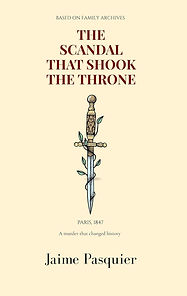
The Scandal That Shook the Throne
Historical Fiction · The Praslin Affair
47 stab wounds. A Duke in flight. A King about to lose his crown.
Paris, 1847. The Duchess Fanny de Choiseul-Praslin is found murdered in her bed, her body bearing the evidence of a savage attack. The prime suspect? Her husband — a Peer of France whose name reaches back six centuries. As Paris erupts in outrage, the monarchy realizes a public trial will expose the rot at the heart of the ruling class.
The official records say the Duke took his own life in a prison cell. My family's records say he was at our dinner table in Nicaragua.
The Scandal That Shook the Throne is built on fifteen years of genealogical research tracing my family's direct descent from the Pasquier and Praslin bloodlines. It reconstructs the most explosive criminal case of the July Monarchy: how a Chancellor of France may have orchestrated the perfect cover-up, allowing a guilty Duke to vanish into Central America.
This is more than a retelling of a famous crime. Inside:
-
The Lost History: Oral traditions preserved before William Walker's forces burned Granada's archives in 1856.
-
The Conspiracy: The political machinery that chose dynasty over justice.
-
The Scapegoat: The story of Henriette Deluzy, the governess who lost everything to a Duke's obsession.
Follow a high-intensity journey from the gilded salons of Paris to the mountains of Nicaragua — where scandal is a weapon, innocence offers no protection, and the powerful have always known how to disappear.
A NOTE FROM THE AUTHOR: This is a short historical novel — a focused reconstruction of the 1847 Praslin Affair. Court records, published testimony, and my own family's archival research are woven together to explore a mystery that textbooks closed too quickly.
"Richly detailed and gripping. Pasquier blends meticulous research with vivid storytelling, turning a real scandal into a sweeping narrative about power, corruption, and the human cost of privilege. Historical fiction with teeth — atmospheric, morally complex, and unafraid to confront the injustices that shaped an era." — Cajetan, Verified Amazon Purchase ★★★★★
"I did not expect the narrative to be so revealing, including the perspectives of everyone involved. It leaves you wondering — will justice always be covered? Will the truth be revealed or buried forever?" — Elizabeth Valdez ★★★★★

The Laws of Desire
Two thousand years ago, a Roman poet named Ovid wrote a manual on seduction. He was witty, cynical, and enormously popular. He was also, eventually, exiled — the emperor did not care for his instruction. His book, the Ars Amatoria, taught men how to find a woman, how to keep her, and then, in a third book he wrote later, taught women how to defend themselves against everything he'd just explained.
The Laws of Desire is that book, rebuilt for the age of the dating app.
The scenery has changed. The chariot races and the colonnades have given way to the profile photo, the read receipt, the sixth first date of the month. But the human material is stubbornly identical: the same vanity, the same waiting, the same small humiliations we agree to endure for the chance of being wanted. Ovid understood this. What he did not understand — what he could not have understood — is that his central metaphor was wrong. He thought love was a siege. He thought you took the city.
This book argues otherwise. It argues that what makes a person worth loving cannot be strategized into existence, that presence is not a technique, and that the only campaign worth waging is the one conducted on yourself.
Written in three books — two addressed to men, one to women — The Laws of Desire is not a self-help manual and offers no five-step programs. It is a long, wry look at what we actually do to each other, and why we keep doing it. Ovid is not the guide here. He is the specimen.
The Last Aristocrats: A Historical Novel
A Peer of France. A murdered duchess. A death that never happened.
In the gray dawn of August 18, 1847, the Duchesse de Choiseul-Praslin was found in her Paris bedroom, her throat cut, her body bearing forty-seven wounds. Her husband — a Peer of France, heir to a name six centuries old — stood accused. But a public trial would have exposed every secret of a rotting aristocracy, and the most powerful men in France could not allow it. Six days later, the Duke was pronounced dead by his own hand. The scandal helped topple a monarchy. It was also a lie.
Behind the sealed coffin, the living Duke was spirited out of France under a dead man's name, in the keeping of a single young guardian — Gaston d'Audiffret-Pasquier, the old Chancellor's heir, bound to carry the secret to the far side of the world. Their road runs from the salons of Paris to the docks of New York and, at last, into the volcano country of Nicaragua.
Spanning thirty-five years and two continents, The Last Aristocrats is a sweeping story of guilt, exile, and the fragile hope of redemption: two men living under borrowed names, the families they make and the families they leave behind, and the women who must decide whether to forgive them. Drawn from real history — and from the author's own fifteen-year genealogical search — it asks the question no court would answer: can a life spent healing ever weigh against a life taken in violence?
The powerful protect their own. The archives burn. But the dead cry out for the truth.
For readers of literary historical fiction — and for anyone moved by the true crime behind Rachel Field's All This, and Heaven Too.
About Jaime Pasquier

Jaime Pasquier is a #1 Amazon Best-Selling Author who writes history, philosophy, and fiction exploring the forces that shape human character and political destiny. His books grow out of a rich family tradition stretching across continents and generations—where questions of exile, survival, and moral inheritance echo through both his life and his work.
Educated in economics at George Mason University and the humanities at Marymount University, Jaime also draws on more than forty years as the founder and CEO of his own financial services firm. This background allows him to bring a unique, multidisciplinary lens to stories about power, morality, and the quiet decisions that alter the course of lives and nations.
In his #1 bestseller, The Virtuous Life: Ancient Wisdom for Modern Living, he traces the philosophical traditions that built Western civilization and asks whether we still possess the character to sustain it. In The Laws of Desire, he turns two thousand years of writing on love toward the way we court, connect, and disconnect today.
His historical fiction opens these same profound questions through a different door. Drawn from fifteen years of genealogical research into his own family history, these novels transform the personal archive into universal story. The Last Aristocrats follows a French peer's murder, staged death, and long exile across two continents. Meanwhile, The Scandal That Shook the Throne and its Spanish-language companion, Cuarenta y Siete Puñaladas, move through royal courts, political intrigue, and the moral trials that define ordinary people in extraordinary moments.
Jaime writes in English, Spanish, and French, and lives in Washington, D.C., where he continues to research and write works that bridge historical insight with contemporary relevance.