Why I Wrote The Virtuous Life
- Jaime Pasquier
- Mar 21
- 3 min read
Updated: Apr 14
The Ancient Thinkers Lit the Torch: The Architects of Progress

By Jaime Pasquier
I didn’t write The Virtuous Life because I had all the answers. I wrote it because I couldn’t shake a feeling — one I suspect many of you share — that something is quietly going wrong.
Not wrong in the obvious, headline-grabbing way. Wrong in a deeper, slower sense. The kind of wrong you sense when you look around at a society that has more wealth, more technology, and more comfort than any civilization in history. Yet, it seems increasingly unable to answer the simplest questions: What are we doing this for? What kind of people are we becoming?
The Call of History
That feeling led me to history. And history, it turns out, is not reassuring. The historian John Glubb spent decades studying the great empires of the past — Persia, Greece, Rome, the Arab Golden Age, Spain, and Britain — and found something startling. Despite their vast differences, every one of them followed the same arc.
Pioneering energy gave way to conquest. Conquest led to commerce, commerce to affluence, and affluence, eventually, to decline. The average lifespan of a great civilization is roughly 250 years. The United States declared independence in 1776. You can do the math.
These civilizations didn’t fall because of outside enemies or natural disasters. They fell from within.
Civic duty gave way to self-interest. Shared purpose dissolved into tribal factions. The virtues that had built the civilization were consumed by the prosperity those virtues had created.
Athens exhausted itself with internal warfare after producing Socrates and the Parthenon. Rome rotted over centuries — its citizen-soldiers replaced by mercenaries, its statesmen replaced by opportunists — long before the Visigoths arrived. The Arab scholars of Baghdad’s golden age, as one medieval moralist observed, stopped pursuing learning for wisdom and started pursuing it for credentials and wealth. Sound familiar?
Learning from the Past
What compelled me to write this book is the realization that we are the first civilization in history with access to the full record of how and why these collapses happened. The Athenians couldn’t study Rome’s decline. The Romans couldn’t learn from Britain’s. But we can study all of them. We can see the pattern with a clarity no previous generation enjoyed.
When I look honestly at our moment — a culture that measures human worth in net worth and social media followers, political discourse reduced to tribal performance, an education system oriented toward credentials over character, and a society drowning in entertainment while loneliness and anxiety quietly spread — I see every symptom the historians documented.
I also see something those fallen civilizations didn’t have: the chance to choose differently.
The real choice before us isn’t between progress and tradition — it’s between progress with character and progress without it.
Every civilization that declined had impressive technology and brilliant minds. What they lost was the moral foundation that had made their achievements possible in the first place.
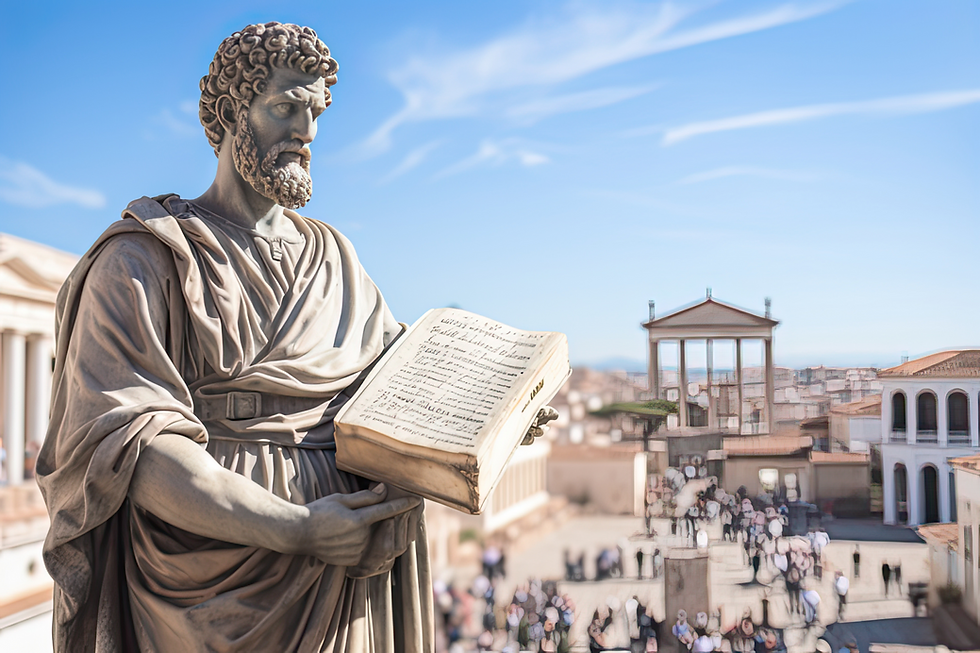
The ancient thinkers understood this. Socrates, Aristotle, the Stoics — they weren’t writing abstract philosophy. They were issuing survival instructions, drawn from watching civilizations rise and fall around them. Their core message has never been more urgent: wisdom, courage, justice, and self-mastery are not optional virtues for the idealistic few. They are the scaffolding that holds a society together.
The Torch of Wisdom
This book is my attempt to recover those instructions and apply them to our moment. Not because the past was better, but because the past contains lessons we ignore at our peril. The ancient thinkers lit the torch. The architects of progress carried it forward. It’s in our hands now.
What we do with it is the question of our age.


Comments